A Holiday to Remember
[Disclaimer: This is a work of fiction. Names, characters, places, events, and incidents are either the products of the author's imagination or used in a fictitious manner. Any resemblance to actual beings, living or dead, or actual events is purely coincidental.]
A familiar holiday, seen through a Malaysian lens, where the most telling moments happen not at the landmarks, but in the margins.
On a packaged holiday to Hainan, a group of recently retired Malaysian women follow the well-worn itinerary of scenic views, cultural encounters, and carefully choreographed shopping stops. The journey becomes less about what is shown than what is concealed — window shades drawn, words lost in translation, and demonstrations that promise health while trading in fear. Moving between compliance and quiet resistance, the protagonist observes the uneasy dance between tourism and commerce, trust and scepticism, friendship and restraint. With humour, unease, and the occasional WhatsApp consultation from an unwelcome expert, this story reflects on what it means to travel, to age, and to choose silence — especially when speaking up may cost more than it saves.
An hour before we were due to land, the announcement came on. We were told that the use of the toilets would close in five minutes, and that we were to return our seats to the upright position and stow away the fold-down tables. I found it odd that they were asking us to do this so soon.
Then came another instruction: all window shades were to be pulled down.
This wasn’t odd. It was strange.
During check-in, I had requested a window seat because Lily, our tour leader, had told me that the scenery during descent was beautiful. On a clear day, she said, one could see the tall Guanyin statue rising from the coast — a three-sided depiction of the bodhisattva, standing at 108 metres, making it one of the tallest statues in the world. Taller even than the Statue of Liberty.
I looked out of the window. There was nothing to see but white, woolly clouds.
That was when a cabin crew member stopped beside me. She was young — at least half my age — composed, and quietly efficient.
“Miss, please pull down the shade in preparation for landing.”
Her tone was polite, but she lingered a second longer than necessary. When I hesitated, she added, just as softly, “Please don’t lift it again. It’s a security matter.”
I did as I was told, secretly pleased that she had called me miss and not auntie, but unsettled all the same. The word “security” stayed with me.
Soon, the entire cabin was dark, save for the muted lights above the overhead compartments and a few focused beams for those who were still reading. The darkness felt deliberate. A question surfaced, uninvited: weren’t window shades usually kept open during take-off and landing?
Visibility mattered, didn’t it? For the crew. For passengers. For anyone outside who might need to look in. Might, as in the case of rescue operations. I pushed the thought aside, though it lingered longer than it should have.
I thought then of MH370.
The thought passed almost as quickly as it came. But once it had arrived, it left behind a quiet residue — an image of an aircraft descending somewhere unknown, its windows darkened, the meaning of fear understood only when it was already too late.
I reminded myself to focus on the here and now. There was a brief, almost inaudible explanation over the PA system about the window shades, but I couldn’t make out a word of it. The other passengers remained unfazed. No murmurs, no puzzled looks. Just quiet compliance.
I tried to rein in my imagination. Closing my eyes only made it worse.
Later, against better judgement, I lifted the shade by barely an inch and peeped out. In those two seconds, all I saw were clouds — still thick, still white, still beneath the bright noon sun. When I was about to attempt a third peep, I noticed a crew member walking towards me. And I remembered her colleague’s earlier words: “It’s a security matter.”
A ridiculous thought crossed my mind: did they have a display in the cockpit showing the window at Seat 34A had been opened, and when?
I looked away quickly. She walked past me, heading towards the rear of the cabin. I exhaled, relieved. Being reprimanded — or worse, detained — upon arrival for breaking rules would be a poor way to begin a holiday.
After that, I decided it was safer to observe. Do nothing.
No further announcement came until we felt the unmistakable screech of wheels meeting tarmac. I checked my watch. It was 3:15 p.m.
The window shades remained closed as we disembarked, descending the steps onto the tarmac and boarding a shuttle bus. The distance between the aircraft and the arrival hall — clearly marked Qionghai Airport — was no more than 150 metres. I thought of the old LCCT at KLIA, where we often walked twice that distance under the open sky if it was an AirAsia flight. Here, half the distance, and we were still ferried by bus. Was this for security reasons too — just like those prohibitive window shades?
Excluding our tour leader, there were thirteen of us in the group, most of them my girlfriends from secondary school — all recently and gracefully retired. Sharon, predictably, announced that she had “retired from patience” and would buy anything that promised better sleep. There were also two men I did not know. With hotel rooms arranged on a twin-sharing basis, I had been told in advance that I would be sharing a room with Lily.
When I spotted Lily in the arrival hall, I smiled and remarked — quite casually — that the Goddess of Mercy statue by the shore was majestically imposing and beautiful. Lily returned my smile without embarrassment and said it was her first time landing at an airport with all the window shades pulled down.
Waiting to receive us was a local guide who took charge of the group from Lily. He was tall, well-groomed, and spoke Mandarin with an air of confidence that bordered on impatience. He introduced himself as Qiang and said that he would be our guide for the next four days.
Janet, the most outspoken among us, asked if he could speak English or Cantonese. Qiang smiled thinly and said he could not.
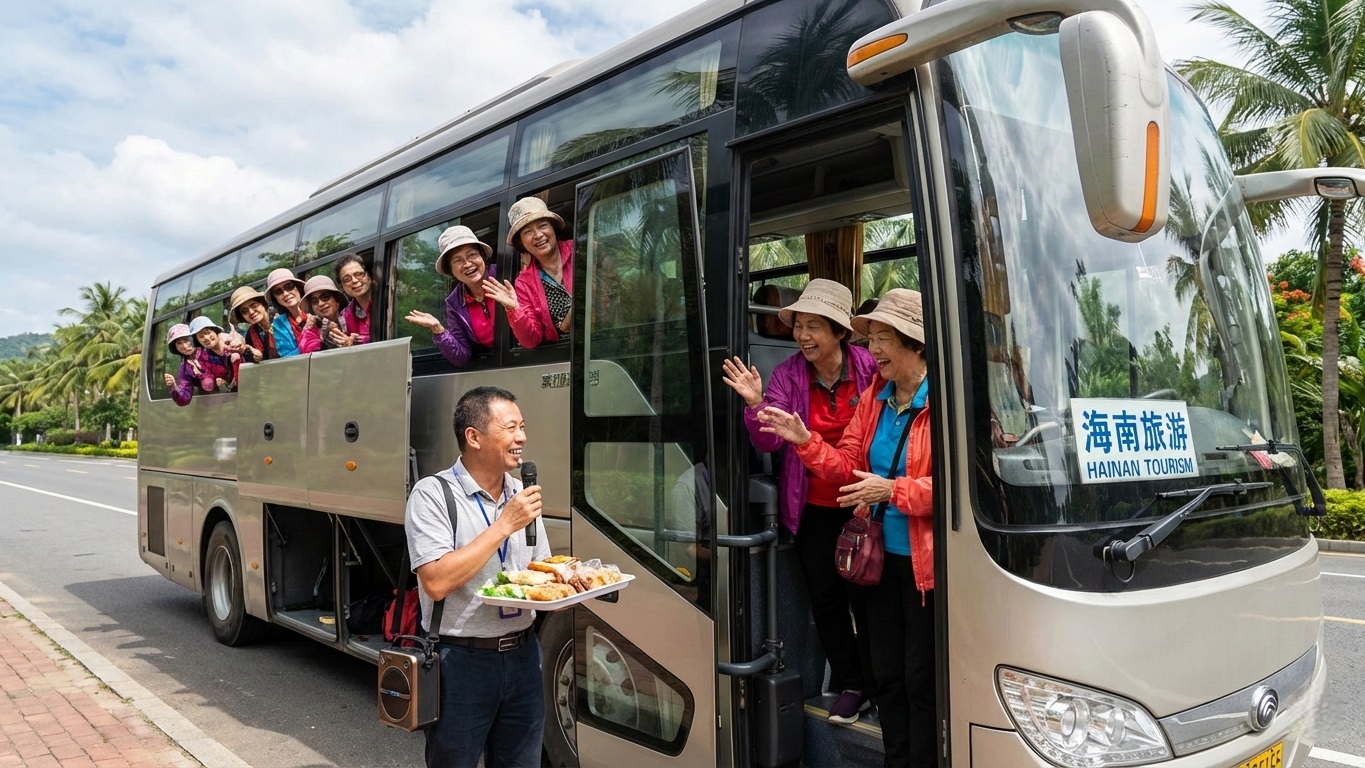
We were ushered into a bus meant for thirty people and were spoilt for choice when it came to seating. As the bus pulled away, Qiang spoke into the microphone. After the usual niceties, he announced that while the trip was supposedly shopping-free, it was not. Anyone who wanted a truly shopping-free trip, he added, should be prepared to pay twice the fare.
“How transparent,” Sharon muttered. “Like muddy water.”
When booking the trip, I had read the fine print of the brochure sent by the agency Lily worked for. It stated: “2 shopping stations: seafood, healthy and wellness center or other. Specialty shops in expressway restaurant stations and shopping stores in scenic spots are not shopping stations.” I was prepared for some amount of leisure shopping. But Qiang’s remark felt entirely uncalled for.
The one and only stop that day turned out to be an eye-opening experience. The special medical zone we visited featured innovative medical devices and research technologies, some of which were pending approval for application. If we did not fully understand Qiang’s Mandarin, we understood even less of the chaperone at the research centre, whose briefing was dense with technical jargon. That night, lying in bed, I thought of my parents and wished they had sent me to a Chinese elementary school.
The following morning, the three-hour bus journey from Qionghai to Sanya was comfortable — if not for Qiang, who spoke excessively about matters unrelated to Hainan. He shared repeated stories about his wife and his mother. I was not brought up to share family matters with strangers. Then again, perhaps what Qiang told us was fictional. I had heard tour guides were good storytellers. But good stories should appeal to their listeners.
His family anecdotes, particularly those about health, soon revealed themselves to be a prelude to his aggressive pre-selling of health products. I fell asleep after an hour of his monologue.
At the shopping station, all fourteen of us including Lily were escorted into a corner for a briefing. Our tour group was not the first Hainan-bound group Lily ever led, but this appeared to be her first visit to a centre specialising in the development and production of marine-based health products, particularly shark liver oil softgels. She appeared attentive but distant. Based on our chat in the hotel room that we shared, I could tell she had opinions; she simply could not afford to voice them.
The place was noisy like a Malaysian night market. Briefings ran simultaneously in the cavernous hall. Despite the din and our limited Mandarin, we understood enough. Slides of human anatomy appeared on a screen. Arteries narrowed. Blood flow slowed.
Fear, when dressed as education, travels fast.
I noticed Lily glance at me once or twice. I kept my face neutral.
The presenter placed two polystyrene bowls on the table. From a bottle labelled Alaska Fish Oil, he squeezed oil from two capsules into the first bowl. Into the second, he squeezed oil from a single shark oil capsule made by his own company.
I thought immediately that we were not comparing like with like. I said nothing.
He passed the bowls around for us to smell, emphasising how much stronger the fishy odour was from the Alaska fish oil. I said nothing.
He poured boiling water into the first bowl. The oil floated. Nothing else happened.
Then he placed the second bowl into a larger plastic container and poured boiling water into it. Within seconds, the polystyrene softened and began to leak. A small collective gasp followed.
I felt Lily shift beside me. Waiting.
I kept my eyes on the table. I said nothing.
The presenter concluded that shark oil cleaned arteries the way it had broken down the bowl. Someone laughed, impressed. Sharon whispered into my ear, “Powerful ah, Robin.”
I remained sceptical, though science was never my field of expertise. I said nothing.
Around me, my travel companions began asking questions, leaning forward, nodding. A few discussed about payment by cash of credit card. One of them laughed lightly and said something I couldn’t catch, but the tone was eager.
While they asked questions and examined the products, I texted my sister, describing what had just happened and asking her to explain. It was a while before her reply came: “I am a dietician, not a chemist. Why don’t you text Leon and ask him?”
My brother-in-law was a chemistry teacher, though not the friendliest family member I had. I was reluctant to trouble such a guy with what I had just witnessed. Knowledgeable as he was, his aloof and distant manner could be irritating. Moreover, a chemistry explanation was neither important nor urgent. I already had committed to a six-month supply of Omega-3 capsules at home, and I had no intention of buying shark oil capsules anyway.
Fifteen minutes later, out of the blue, a message from Leon appeared on my phone.
“SCAM.” Written in uppercase.
It was Sunday. I assumed my sister and Leon had slept in and might have been talking over brunch. In a terse reply, I typed: “How so?”
“Shark oil contains high levels of squalene, which is a cholesterol precursor. The product itself is not a scam. But cardiologists are wary of supplementing cholesterol precursors. The demonstration you witnessed is a lie. The ‘powerful cleaner’ lie is a scam. Our arteries are living tissue, not plastic pipes. Plaque is not grease stuck to the walls of a pipe. Anything that ‘cleans’ arteries like that could damage blood vessels, rupture cell membranes, and possibly cause internal bleeding.”
I wondered briefly when a chemistry teacher turned into a medical doctor. “Too technical for me,” I texted back. “Explain why the bowl leaked in simple layman terms,” I wrote, adding layman deliberately to discourage further complexity.
“Check the bowls,” he replied. “The one used for the shark oil could have been pre-weakened or treated with a solvent or alcohol-based carrier, invisible to the naked eye. Pour boiling water into a compromised polystyrene bowl and it will leak — with or without oil in it.”
“Thank you.” I remember my manners. End of consultation. But checking the bowls would be confrontational and risks breaching security. This wasn’t the time to create a scene. I did nothing.
“Even if something is strong enough to break a polystyrene bowl, it doesn’t mean it can clean your veins. Otherwise, you should drink gasoline to lower your cholesterol.” Leon’s last message came in. When I saw his laughing emoji to his petrol analogy, I felt the familiar prickle of irritation. Being right was never enough for Leon; one also had to be made to feel small.
By the time we regrouped, my travel mates had contributed almost RMB70,000 to the shopping station’s revenue. I kept Leon’s explanations to myself. Lily said nothing. Qiang beamed.
I do not doubt that shark oil and related products may offer some benefit. China, after all, would come down hard on products proven harmful if marketed openly. Nothing comes from nothing. I can only hope my friends will reap some return on their faith.
Besides Qiang peddling his assortment of snacks on the bus the following day, we were taken to a small supermarket building that catered exclusively to tour groups. Ten coaches were already there. Inside, we were guided into a room and instructed to sit through a thirty-minute presentation on products made from bamboo and its by-products.
The presenter spoke with evangelical enthusiasm about blankets, bedsheets, clothing, shoes and towels. Bamboo, it seemed, could now clothe, warm, and cushion every part of the human body. As she extolled its many virtues, my thoughts drifted to the pandas in Chengdu, whose staple diet probably needed to be steadily repurposed so that humans might sleep more comfortably at night.
Once again, I spent not a single cent there, unlike many of my companions. Perhaps I was a terrible tourist — or simply a tired one.
The visit to the ethnic minority Li community, however, was genuinely eye-opening. While many nonagenarian women elsewhere in the world — like my late grandmother — might spend their final days resting or fussing over their great-grandchildren, Li women continued to weave cotton well into old age. Their craft was not merely labour; it was memory, dignity, and belonging woven into cloth. Even as the modern world hurried past them, they remained relevant and respected within their own community. That, to me, was real women power.
But Qiang, ever the professional, did not miss the moment. We were seated once more, this time listening to representatives promote their silverware. Fortunately — or perhaps unfortunately — most of my comrades were financially depleted after earlier investments in health supplements, bamboo-related products, and Qiang’s snacks. And our recent investment in gold, gold funds and gold stocks before our trip spared us further temptation by silver.
On the flight home, the windows in the waiting lounge were plastered over, offering no view of the tarmac or the sky beyond. When we boarded, we noticed the window shades were already pulled down. For the first hour in the air, there was nothing to see. Nothing. Only the familiar cabin, the passengers, and ourselves.
I did not think about shark oil, or commissions. Or Leon’s science lessons via Whatsapp messages. I thought instead about Lily and how she had to sit through sales pitches unrelated to her job as a tour leader. I thought about how travel reveals us — not so much the places we visit, but the habits we carry with us, and the stories we choose to believe. That, I realised, was the most memorable part of the holiday.
(Footnote: Polystyrene is a non-polar polymer held together by weak intermolecular forces. In the demo, the second bowl is believed to have been pre-treated with a high-concentration solvent — most commonly Isopropyl Alcohol.
While the alcohol evaporates within minutes and leaves the bowl looking, smelling, and feeling dry to the touch, it creates a phenomenon called Environmental Stress Crazing. This process introduces a network of microscopic fissures (crazes) that permanently weaken the polystyrene’s “skeleton.”
The trick is activated by thermal stress. When boiling water is poured into the compromised bowl, the heat forces the plastic to expand. The pre-damaged polymer chains pull apart, causing the “miraculous” leak. The addition of fish oil acts as a secondary surfactant, further lowering the surface tension and allowing the liquid to penetrate the newly opened fissures even more rapidly.)
* * * * *